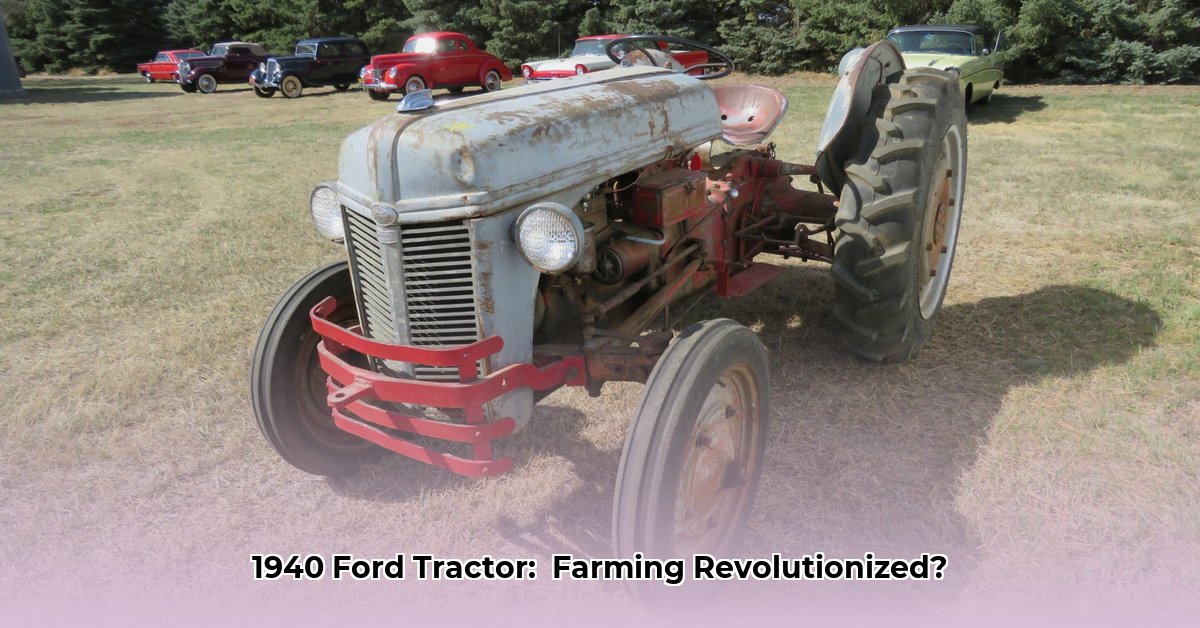
A Quiet Revolution on the Farm
The year is 1940. World War II casts a long shadow, yet on American farms, a different kind of revolution is quietly unfolding. It's not the roar of tanks or the shriek of fighter planes, but the steady chug of a remarkable machine: the Ford 9N tractor. This isn't just a story about a tractor; it's a narrative of innovation, ambition, bitter legal battles, and the lasting impact of a simple machine on an entire industry. It's a story about how a single invention transformed farming, and continues to capture the hearts of collectors and enthusiasts alike. For more on Ford tractors, check out this useful resource.
Did you know that the seemingly simple design of the 9N actually revolutionized agricultural practices? Its impact is a testament to ingenuity and the power of accessible technology. This article delves into the technical specifications, historical context, and the captivating human story behind this iconic machine.
A Partnership Forged in Steel (and Lawsuits!)
The Ford 9N’s genesis wasn’t a solitary endeavor. It was the product of a collaboration—a powerful yet ultimately fractured partnership between Henry Ford, the automotive titan, and Harry Ferguson, a visionary agricultural engineer. Their combined brilliance created a game-changing innovation: the three-point hitch system. This ingenious system dramatically simplified the attachment and detachment of farm implements, dramatically increasing farming efficiency.
However, this innovative partnership ended in a protracted legal battle. The core of the dispute? The interpretation of their contract regarding the three-point hitch and the distribution of profits. The disagreement highlights that even the most successful collaborations can sometimes end in acrimony. What started as a groundbreaking partnership ended up in a courtroom, proving that even in the world of groundbreaking inventions, human disagreements create unforeseen challenges.
The 9N: Under the Hood
What made the 9N so revolutionary? Let’s examine its technical specifications. The 9N boasted a four-cylinder, approximately 120 cubic inch (1967 cc) engine, cleverly adapted from existing Ford car parts. This shrewd design significantly lowered production costs, making the tractor far more accessible to the average farmer. Its simplicity was a feature, not a flaw. Farmers could easily perform their own repairs, saving money and keeping their operations running smoothly. While its three-speed transmission was unpretentious, it proved remarkably efficient in handling the demands of plowing, planting, and harvesting. The simplicity of this reliable workhorse proved to be a cornerstone of its wide-spread adoption.
Beyond the Farm: Unexpected Adventures
The 9N's capabilities extended beyond the farm. Its surprising versatility caught the attention of the U.S. military. Both the Navy and the Air Force adopted it as a small tug, affectionately nicknamed the "Moto-Tug," proving its strength and adaptability in transporting essential supplies and equipment around bases. This unexpected adoption underscores the tractor's unexpected adaptability and robustness, highlighting its impact beyond the agricultural sector.
The N-Series: A Legacy of Innovation
The 9N's success was not a fleeting moment. It initiated a lineage of tractors, the N-series, culminating in the highly successful 8N. Each iteration improved upon its predecessor, leading to even greater efficiency and reliability. The 8N, in particular, enjoyed phenomenal success in North America, cementing the Ford N-series' place in agricultural history. These tractors didn't simply improve farming; they transformed it entirely, impacting designs and standards for decades.
A Comparison of Early N-Series Tractors
| Model | Engine (Approximate Cubic Inches) | Transmission | Three-Point Hitch | Notable Features |
|---|---|---|---|---|
| 1940 Ford 9N | 120 | Three-speed | Mechanical | Introduced the revolutionary three-point hitch. |
| Ford 2N | 120 | Three-speed | Mechanical | Refined design, improved components. |
| Ford 8N | 120 | Three-speed | Hydraulic (later) | Improved reliability, hydraulic hitch became standard later. |
How to Value a Vintage Ford 9N Tractor for Sale
So, you're considering buying or selling a vintage Ford 9N? Determining its value is more nuanced than simply looking at a price list. Several factors determine the worth of your classic machine, creating a fascinating blend of history, mechanics, and current market trends.
Assessing the Tractor's Condition
The condition of the tractor plays a pivotal role in its valuation. Is it a barn find, needing complete restoration? Or a meticulously restored showpiece? Key aspects to consider include: completeness of original parts, engine performance (compression tests are vital!), transmission functionality, sheet metal condition (rust is a major factor), paint (original paint carries more value), tire condition (original tires, even if not roadworthy, are a plus!), and any included accessories (original implements significantly increase value).
Researching Market Values
Thorough research is paramount. Explore online resources, specialized vintage tractor publications, and local auction results for a realistic understanding of current market prices. Focus on sold listings rather than asking prices to avoid unrealistic expectations. Keep in mind that geographical location influences value; high-demand areas often command higher prices.
Considering Restoration Costs
If the tractor requires restoration, factor in the associated expenses. Parts availability varies. Some components are readily available, while others require extensive searching. Labor costs also depend on your skills and whether you'll outsource the work.
The Price Equation: A Balancing Act
The final price is a balance between condition, market trends, and restoration needs. Imagine a spectrum: a "parts tractor" needing extensive work at one end, and a concours-level restoration at the other. Your 9N's place on this spectrum determines its value.
Legal Considerations and Documentation
Having clear documentation, including proof of ownership and service history, is crucial. It enhances buyer confidence and can increase the asking price. This is not just about the tractor's mechanical value but also its legal standing and transaction security.
The Ford 9N's story is a testament to human ingenuity and its lasting impact on agriculture. It's a compelling narrative that blends technical innovation with a human story of partnership, conflict, and an enduring legacy that continues to resonate today.